
How to extend the lifespan of your refrigerator by 5+ years
David Collins, appliance service expert | February 26, 2026 | Appliance Maintenance
Your refrigerator is probably the hardest-working appliance in your home. It runs 24/7, keeps your food fresh, and costs anywhere from $800 to $10,000 depending on the model. So when we tell you that most refrigerators die years before they should, it’s worth paying attention.
The average refrigerator lasts 10-15 years, but we’ve seen well-maintained units running strong at 20+ years. We’ve also seen expensive models die after 6 years because nobody did basic maintenance. The difference? Usually just a few simple habits that take minutes but add years to your fridge’s life.
After fixing thousands of refrigerators across Atlanta, Lawrenceville, and Buford, we know exactly what kills refrigerators early and how to prevent it. Let’s talk about how to keep yours running for years longer than expected.
Why refrigerators die early and how to prevent it
Most refrigerator failures aren’t random bad luck. They’re predictable problems caused by neglect or misuse. Here are the top killers we see:
- Dirty condenser coils: this is the number one cause of premature compressor failure. Dusty coils make the compressor work harder, run hotter, and die sooner. We’ve seen $2,000 compressors fail because nobody spent 10 minutes vacuuming coils.
- Overworked compressor: when door seals leak, coils are dirty, or the fridge is overstuffed, the compressor runs constantly trying to maintain temperature. This is like driving your car in first gear on the highway—it’ll burn out.
- Temperature extremes: setting your fridge too cold wastes energy and strains components. Too warm and food spoils while the compressor struggles to catch up.
- Mechanical wear from poor placement: unlevel fridges, inadequate ventilation, or exposure to heat sources accelerate wear on everything from compressor mounts to door hinges.
- Neglected seals and gaskets: bad door seals let cold air escape. The compressor compensates by running longer. Eventually, it fails.
Every one of these problems is preventable. We offer comprehensive refrigerator repair and maintenance services throughout the Atlanta metro area.
The most important thing for fridge lifespan: clean condenser coils
We can’t stress this enough. If you do nothing else on this list, clean your condenser coils twice a year. This single task can add 5+ years to your refrigerator’s life by preventing compressor failure. Here’s how to do it:
- Locate the coils: most refrigerators have coils on the back or underneath. Check your manual if you’re not sure.
- Unplug the fridge: safety first.
- Vacuum thoroughly: use a brush attachment or a coil cleaning brush (available at hardware stores for under $10). Get all the dust, pet hair, and debris out.
- Wipe down the area: clean the floor and wall behind the fridge while you’re at it.
- Plug back in: push the fridge back, leaving a few inches of space for airflow.
Do this in spring and fall, and mark it on your calendar. If you have pets, do it quarterly. Seriously—this alone prevents most refrigerator compressor problems we see.
Check and replace door seals regularly
Door seals (also called gaskets) are the rubber strips that line the fridge and freezer doors. When they fail, cold air escapes constantly, making the compressor work overtime.
- Test your seals: close the door on a dollar bill. If you can pull it out easily, the seal is weak. Test all around the door.
- Clean them monthly: wipe seals with warm soapy water to remove food residue and mold. Dry thoroughly.
- Check for cracks: look for tears, cracks, or hardened areas. These need immediate replacement.
- Replace when needed: replacement seals cost $50-150 depending on your model. That’s cheap compared to a $500+ compressor replacement.
High-end brands like Sub-Zero have particularly precise seals. We’ve seen homeowners ignore worn seals on a $8,000 Sub-Zero and end up needing major repairs. Don’t make that mistake.
Maintain proper temperature settings
Your refrigerator has an optimal temperature range. Too cold wastes energy and stresses the compressor. Too warm spoils food and makes the unit work harder. Ideal temperatures are 37–40°F for the refrigerator and 0–5°F for the freezer.
- Use a thermometer: don’t trust the dial settings. Put an appliance thermometer inside and verify the actual temperature.
- Adjust seasonally: in hot Atlanta summers, you might need slight adjustments. Monitor and tweak as needed.
- Don’t overfill: air needs to circulate. An overstuffed fridge can’t maintain even temperatures, forcing the compressor to cycle more frequently.
Other refrigerator setup and maintenance essentials
A properly installed and maintained refrigerator runs more efficiently, lasts longer, and breaks down less often. Start with leveling: an unlevel fridge can cause poor door sealing, improper compressor oil flow, and drainage issues. Place a level on top (front-to-back and side-to-side), adjust the front feet as needed, and aim for a slight backward tilt so doors close naturally. Always recheck the level after moving the unit.
Next, give your fridge enough space to breathe. It needs airflow around the condenser coils to release heat, so leave at least 1–2 inches on the sides, 2–3 inches on top, and 2–3 inches behind (unless it’s a built-in model). Avoid placing it near ovens, dishwashers, or direct sunlight, as external heat forces the compressor to work harder. Built-in refrigerators still require proper ventilation—make sure vents are never blocked.
Ice makers and water dispensers need regular care to avoid common failures. Replace water filters at least every 6 months to maintain proper flow, clean the ice bin monthly, and inspect water lines for leaks or buildup (replace them every 5–7 years). If you rarely use the ice maker, turn it off to reduce wear and prevent stale ice.
Interior cleaning also plays a role in performance. Wipe spills immediately to prevent liquids from freezing in vents, do a deep clean every few months, and check the drip pan underneath the fridge twice a year to prevent mold. Make sure door bins are intact and secure to avoid seal damage.
Finally, pay attention to sounds. Normal operation includes light humming, occasional clicking, and soft fan noise. But loud grinding, constant clicking, squealing, or banging are warning signs. Unusual noises usually mean a problem that will only get worse if ignored, so it’s best to act early.
The main rule is to address problems immediately
Small problems become big problems. Fast. Here’s what needs immediate attention:
- Water leaks: even small puddles indicate a problem. Could be a clogged drain, bad seal, or worse. Our guide on why refrigerators leak water can help you troubleshoot.
- Temperature fluctuations: if food is freezing in the fridge or melting in the freezer, something’s wrong with the thermostat or airflow.
- Frost buildup: excessive frost in a frost-free freezer indicates a defrost system problem.
- Error codes: modern fridges display error codes. Look them up in your manual and address them. For Samsung and LG refrigerators, we see specific error codes frequently—don’t ignore them.
- Warm fridge: if your fridge isn’t cooling properly, check out our Samsung vs LG refrigerator problems comparison for brand-specific troubleshooting.
When we say “address immediately,” we mean it. A $150 repair today prevents a $800 repair next month.
Brand-specific fridge maintenance tips
Different brands need different attention. Here’s what we’ve learned from thousands of repairs:
- Sub-Zero: these are built to last 20+ years, but only with professional maintenance. Don’t skip the recommended annual service. Read our article on what makes Sub-Zero different to understand why.
- Samsung: ice makers are a known weak point. Clean them religiously and replace water filters on schedule.
- LG: compressors on certain models have had issues. If yours is affected, get it checked even if it’s running fine.
- GE: solid and reliable, but condenser coils need frequent cleaning, especially on bottom-mounted models.
- Whirlpool/Maytag: straightforward designs, easy to maintain. Still need regular coil cleaning and seal checks.
- Bosch: European models sometimes have different filter requirements. Follow manufacturer specs exactly.
When to call for professional refrigerator maintenance
Some maintenance you can do yourself. Some require professional expertise. Here’s when to call us:
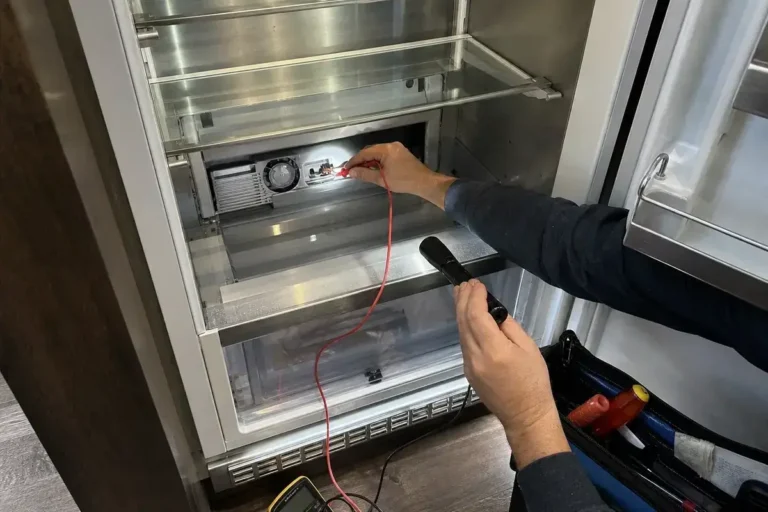
- Annual checkup: like a car, refrigerators benefit from yearly professional inspection. We check things you can’t easily access—refrigerant levels, compressor health, electrical connections, and control boards.
- After 7-8 years: even if nothing seems wrong, have a tech inspect the major components. Catching wear early prevents catastrophic failure.
- Before warranty expires: if you have an extended warranty, use it. Get a full inspection while you’re still covered.
- Any time performance declines: temperature inconsistencies, unusual sounds, or increased energy bills all warrant professional diagnosis.
Conclusion
Your refrigerator can easily last 15-20 years with proper care. Most die at 10-12 because nobody did basic maintenance. The difference between a fridge that dies at 10 and one that runs strong at 20 is usually just cleaning coils, checking seals, and maintaining proper temperature.
None of this is complicated. None of it requires special tools or expertise. It just requires consistency.
And when something does go wrong? Call us early. We’ve seen too many homeowners turn a $150 fix into a $1,500 disaster by waiting. At Appliance Tech Pros, we’re here to help you keep your refrigerator running efficiently for as long as possible.
Contact us at (770) 501-4267 for refrigerator maintenance or repair throughout Lawrenceville, Atlanta, Marietta, Suwanee, and the entire metro area. Your fridge is worth taking care of—let us help.